



Where Is Coffee Imported From Top Exporting Countries by Volume
Every cup of coffee traces back to one of a relatively small number of countries responsible for growing and exporting the overwhelming majority of the world’s supply, and understanding where is coffee imported from at a global level means understanding this concentrated production landscape rather than any single importing country’s specific sourcing pattern. This concentration has real practical consequences too, since global coffee prices, availability, and quality trends all shift meaningfully based on conditions in just a handful of dominant producing countries, making the export leaderboard covered throughout this guide directly relevant to anyone trying to understand price movements or supply disruptions reported in coffee industry news. This guide walks through the world’s leading coffee exporting countries by volume, what makes each origin distinct, and what this concentration actually means for buyers building a sourcing strategy in 2026.
Where Is Coffee Imported From A Global Production Snapshot
Global coffee production reached a forecast record of roughly 178.8 million 60-kilogram bags for the 2025 to 2026 crop year, with total global exports projected around 123.8 million bags, both figures reflecting genuine growth driven largely by recovery in Vietnam and Indonesia alongside record output from Ethiopia. This concentration matters directly for anyone asking where is coffee imported from, since a relatively small handful of countries, led overwhelmingly by Brazil and Vietnam, together account for a majority share of everything traded internationally, making global supply genuinely sensitive to conditions in just these top few origins. This record supply year also arrived after a genuinely turbulent period, inventories had fallen to their lowest levels since 2018 following earlier climate-related disruption, and prices had more than doubled at points during that tighter supply period, illustrating just how quickly conditions in these concentrated producing regions can swing the entire global market from scarcity to relative abundance within a couple of growing seasons.
Brazil the World’s Largest Coffee Exporter
No answer to where is coffee imported from is complete without starting with Brazil, which holds the top position by an enormous margin over every other producing country.
Production Scale and Export Volume
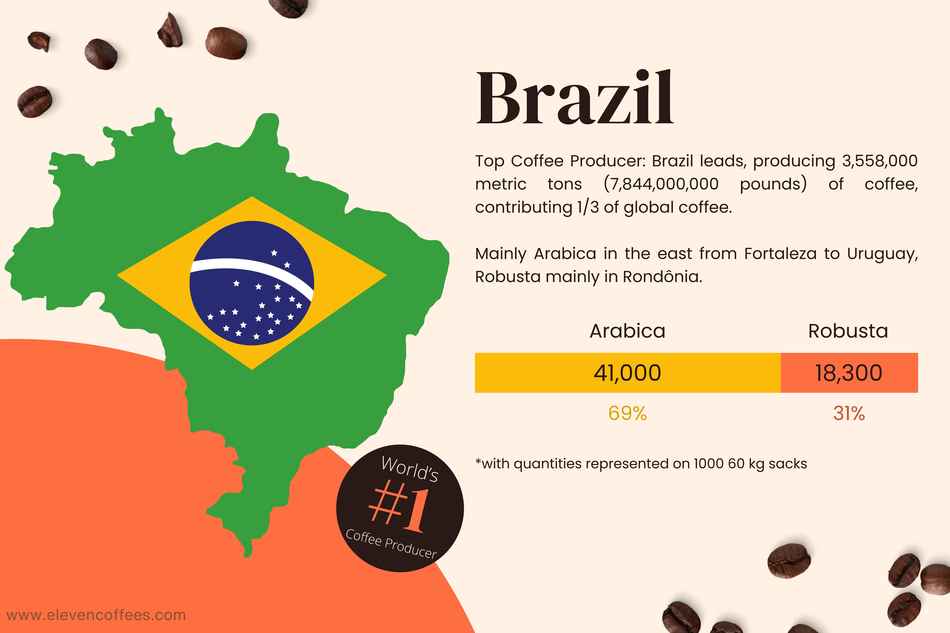
Brazil produces somewhere between 63 and 70 million 60-kilogram bags annually depending on the specific season and source cited, representing roughly 35 to 37 percent of total global coffee production, with export volume typically running between 45 and 50 million bags each year. This scale isn’t a recent development either, Brazil has held the position of world’s largest coffee producer and exporter for well over a century, built on a combination of favorable growing conditions, large mechanized farm operations, and export infrastructure that smaller producing countries simply can’t match in scale. This dominance means that even relatively modest year-over-year shifts in Brazilian output, whether from favorable or unfavorable weather, ripple through global pricing in a way that a comparable percentage shift in a smaller producing country’s output simply couldn’t replicate given how much smaller that country’s absolute contribution to total global supply actually is.
Production Scale and Export Volume
Arabica and Robusta Together
Brazil stands out among major producers specifically for growing significant commercial volumes of both Arabica and Robusta, known locally as Conilon, with Arabica generally representing around 70 percent of the country’s output and Robusta making up the remaining share. This dual capability gives Brazilian coffee genuine versatility, serving both premium single-origin Arabica applications and high-volume commercial blending needs that require Robusta’s characteristics, making Brazil difficult for any single alternative origin to fully replace in a diversified global supply chain, and it explains why so many roasted coffee wholesale programs built around consistent, large-scale supply default to Brazilian sourcing as a dependable foundation.
Vietnam the World’s Largest Robusta Exporter
Vietnam holds firmly onto second place in global export volume, and its specific role within the global supply chain differs meaningfully from Brazil’s broader dual-varietal position.
Vietnam Production Scale and Growing Regions
Vietnam produces approximately 30 to 31 million 60-kilogram bags annually, positioning it as the clear second-largest coffee exporter globally and, more specifically, the world’s largest single supplier of Robusta by a wide margin. Production concentrates heavily in the Central Highlands provinces of Dak Lak, Gia Lai, and Dak Nong, where warm, humid lowland conditions suit Robusta cultivation particularly well, while smaller volumes of Arabica and increasingly regarded Fine Robusta come from higher-altitude regions including Lam Dong and Kon Tum. Vietnam’s rise to this position happened relatively recently in coffee industry terms, largely following the country’s economic reforms in the late 1980s, when Robusta’s hardiness and yield made it the practical crop of choice for rapid agricultural expansion, transforming Vietnam from a minor producer into the dominant global Robusta supplier within just a few decades.
Vietnam Growing Specialty Reputation
Beyond raw volume, Vietnam has genuinely expanded its specialty positioning over the past decade, with Fine Robusta from careful processing and select high-altitude Arabica lots increasingly reaching international specialty buyers who previously associated Vietnamese coffee purely with commodity-grade volume. This shift matters for anyone asking where is coffee imported from specifically for specialty applications, since a genuine specialty coffee supplier based in Vietnam now offers a real alternative tier alongside the country’s traditional volume-focused Robusta export base, giving buyers meaningfully more sourcing flexibility than the country’s historical commodity-only reputation would suggest.
Colombia and the Washed Arabica Standard
Colombia holds third place globally, producing approximately 12.9 to 13.5 million 60-kilogram bags annually, exclusively Arabica grown at elevations between 1,200 and 2,000 meters across the Andean mountain regions. The Colombian Coffee Growers Federation enforces mandatory export quality standards nationally, meaning the baseline quality floor for Colombian green coffee entering international trade sits meaningfully higher than many other origins where no equivalent centralized quality enforcement exists. Regions including Nariño, Huila, and Antioquia regularly produce lots scoring in the 85 to 90 point range on the SCA cupping scale, and Colombia’s two harvest cycles in many growing regions give international buyers more scheduling flexibility than single-harvest origins typically offer. This institutional quality enforcement, largely unique among the world’s top exporting countries, has helped Colombian coffee maintain a consistently strong reputation in international markets over many decades, even as newer or less centrally organized origins have sometimes struggled with more variable quality perception among international buyers less familiar with their specific quality control systems.
Indonesia and Ethiopia Rounding Out the Top Five
The remaining two positions in the global top five each bring genuinely distinct characteristics to the international supply picture.
Indonesia Diverse Robusta and Arabica Supply
Indonesia produces roughly 10.9 million bags annually, supplying both Robusta and specialty Arabica from geographically distinct growing regions including Sumatra and Sulawesi, each associated with their own distinctive processing traditions and flavor characteristics. This diversity within a single exporting country gives Indonesia a somewhat unique position among top exporters, functioning simultaneously as a commodity Robusta source and a specialty Arabica origin depending on which specific region and processor a buyer sources from.
Ethiopia the Birthplace of Coffee
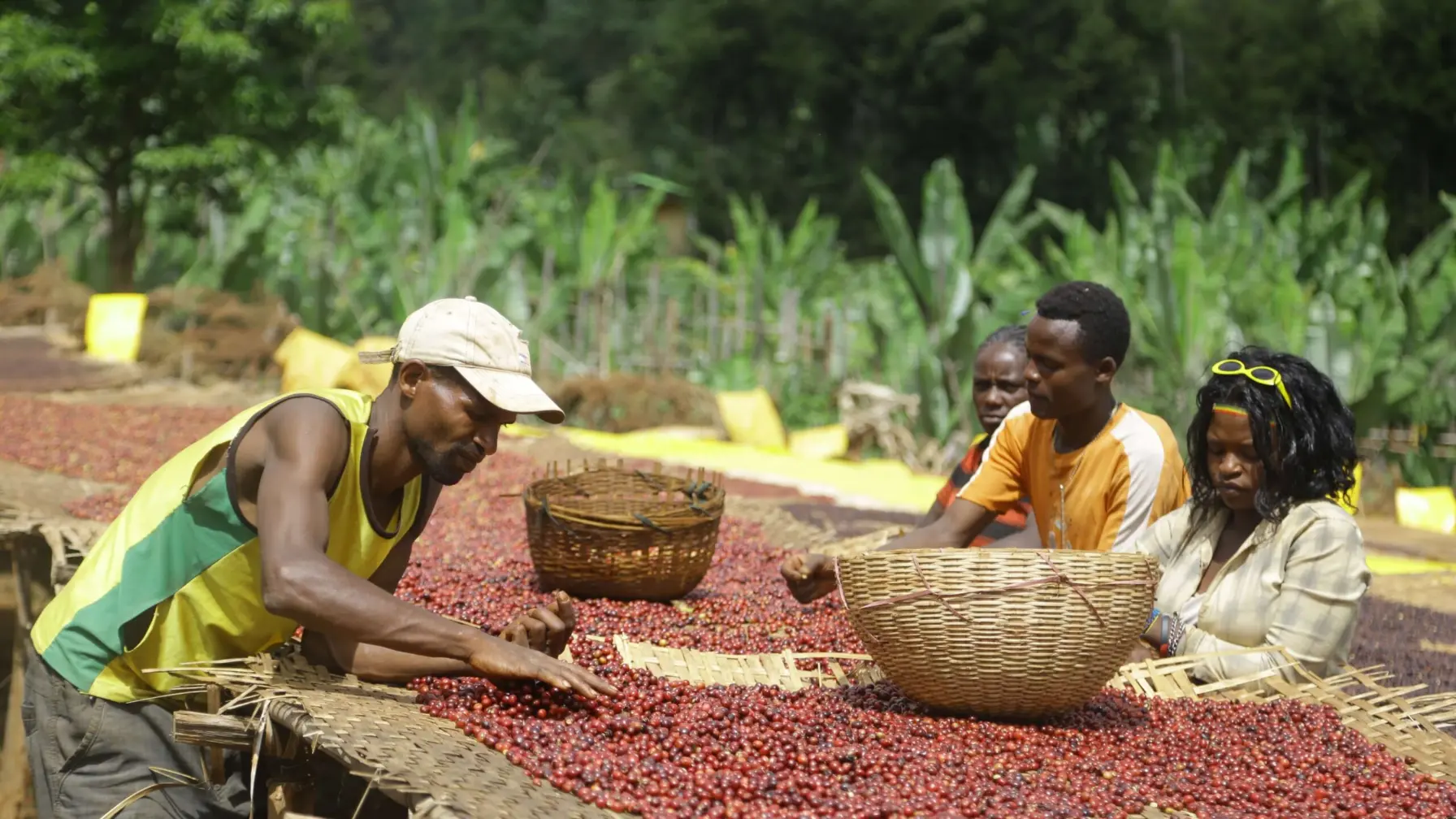
Ethiopia rounds out the top five with approximately 8.36 million bags annually, holding particular significance as coffee’s original birthplace and a production base built overwhelmingly on smallholder farming rather than the large mechanized operations common in Brazil. This smallholder structure creates genuinely traceable supply chains that appeal strongly to specialty buyers, and Ethiopia’s export volume has continued expanding due to strong global demand for its distinctive, often fruit-forward and floral Arabica characteristics tied to the country’s high-altitude growing conditions and remarkable diversity of heirloom varietals. Ethiopia’s genetic diversity specifically sets it apart from every other major exporter, since the country is home to thousands of distinct coffee varietals that developed over centuries in the wild forests where coffee originated, a genetic resource no other producing country can claim at anything close to the same scale, giving Ethiopian coffee a flavor range that other origins, however well-managed, simply can’t replicate from their own more genetically limited cultivated varietals.
Ethiopia the Birthplace of Coffee
Smaller But Significant Exporters
Beyond the top five, several additional countries contribute meaningfully to answering where is coffee imported from on a global scale. Honduras has emerged as Central America’s largest coffee producer, exporting roughly 5.18 million bags annually, known for sweet, fruity, and complex flavor profiles from growing regions including Copán and Montecillos. India exports close to 390,000 metric tons annually, drawing on both Arabica and Robusta production across its southern states, with Monsooned Malabar representing one of the country’s most internationally recognized specialty offerings, a distinctive processing method involving controlled exposure to monsoon winds that produces a uniquely low-acid, full-bodied cup unlike anything else in global specialty coffee. Uganda has also posted meaningful production growth in recent seasons, contributing to the broader global supply recovery alongside Vietnam and Indonesia that’s helped push total global export volume toward its current record levels, and Peru continues to supply a smaller but steady volume of certified organic and fair trade Arabica that appeals specifically to buyers prioritizing these certifications alongside cup quality.
What This Concentration Means for Global Buyers
Understanding where is coffee imported from at this level of concentration matters directly for how businesses think about building resilient sourcing strategies. A business considering a roasted coffee wholesale relationship built around a single dominant origin, Brazil specifically given its outsized share of global supply, benefits from understanding just how much of the entire global market depends on conditions in that one country, since a climate event or trade disruption affecting Brazil specifically ripples across the entire global coffee market given its scale.
Businesses evaluating a ground coffee wholesale product line have genuine reason to consider sourcing outside the very largest exporters specifically, since a smaller but well-managed origin like Honduras or a specific Indonesian growing region can offer genuine flavor differentiation compared to products built purely around Brazilian or Vietnamese commodity volume that dominates so much of existing global supply.
For businesses working with a genuine specialty coffee supplier, this global production picture reveals real opportunity in origins beyond the very top of the volume ranking, since smaller exporters like Ethiopia and increasingly Vietnam’s Fine Robusta segment often deliver more differentiated flavor and traceability than the sheer scale of Brazil’s production can practically support across its enormous total volume.
Diversifying Across Multiple Exporting Origins
Businesses building a broader specialty coffee wholesale program specifically benefit from sourcing across several of these top exporting countries rather than depending entirely on any single origin, since this diversification provides genuine protection against the kind of climate or trade disruption that has repeatedly affected individual top producers over recent years.
Businesses evaluating instant coffee wholesale sourcing at scale should also weigh this concentration risk directly, since building supply relationships across both Brazil and Vietnam specifically, the two dominant Robusta-capable origins, provides more resilient sourcing than depending on either single country alone for commodity-grade soluble coffee production.
Buyers planning a larger instant coffee bulk buy specifically benefit from understanding which of these top exporting countries actually supply the Robusta base most instant coffee formulations depend on, since Vietnam and Brazil together account for the vast majority of globally traded Robusta, making sourcing decisions for this specific format considerably more concentrated than sourcing decisions built around Arabica-focused specialty positioning.
A drip coffee supplier building a differentiated single-serve product line similarly benefits from looking beyond the very largest exporters specifically, since a smaller, more traceable origin often supports the kind of origin storytelling that helps a convenience-format product stand out against competitors sourcing generically from whichever major exporter happens to offer the lowest price at a given moment.
Getting Started
Whether you were simply curious where is coffee imported from at a global level or the question led you to think more strategically about your own sourcing diversification across these leading exporting countries, understanding this concentrated production landscape gives you a genuinely informed foundation for building a resilient supply strategy. Looking to diversify your coffee sourcing with a supplier from one of the world’s leading exporting regions? Request a sample and a conversation with 1300’S Coffee to explore Vietnamese origin options for your business.
Read more: Where Does the US Import Coffee From Volume and Top Source Countries


1300s BLOG YOU MAY ALSO BE INTERESTED IN
Why Vietnam Is Becoming a Global Specialty Coffee Origin
Is the Coffee Industry Growing? Market Trends and Growth Drivers
Top 10 Speciality Coffee Suppliers with Export Standard Production