

Top Specialty Coffee Suppliers for European Coffee Importers
Europe is the largest specialty coffee market in the world, and its specialty segment has been growing faster than the overall coffee category for years. That growth has changed what European importers actually evaluate when comparing specialty coffee suppliers and specialty coffee companies in origin countries like Vietnam. Price and cupping score still matter, but they now sit alongside questions that didn’t exist a decade ago: Can this supplier produce a compliant Due Diligence Statement under the EU Deforestation Regulation? Does their organic or Rainforest Alliance certification come from a body the European Commission actually recognizes? Can they document the geolocation of the specific plots a lot came from?
This guide walks through what European buyers should check before shortlisting specialty coffee suppliers, profiles several Vietnamese companies with an established EU presence, and looks at where a smaller, vertically integrated producer fits alongside the country’s largest exporters.
The Regulatory Layer That Now Shapes EU Sourcing Decisions
EU Deforestation Regulation (EUDR)
This is the single biggest compliance shift affecting coffee imports into the EU right now. Following a second postponement confirmed in December 2025, the regulation applies to large and medium operators from 30 December 2026, with micro and small enterprises given until 30 June 2027. Once in force, every shipment of green, roasted, or processed coffee entering the EU needs a Due Diligence Statement carrying geolocation coordinates for the specific plots the coffee was grown on, along with evidence that the land wasn’t deforested after 31 December 2020. The practical effect for buyers: a supplier’s geolocation mapping coverage is no longer a nice-to-have detail, it’s the difference between a shipment clearing customs and one that doesn’t. Coverage varies widely across Vietnamese exporters, from large multinational-backed operations already mapping the majority of their growing plots, to smaller specialty exporters working through cooperative partnerships where coverage is inconsistent. Ask any supplier directly what percentage of their supply is currently geo-mapped rather than accepting a general assurance.
EU Deforestation Regulation (EUDR)
EU-Vietnam Free Trade Agreement (EVFTA)
Since taking effect, EVFTA has reduced import duties on green, roasted, and processed coffee from Vietnam into the EU to zero, and it protects 39 Vietnamese geographical indications, including Buon Ma Thuot coffee, from being used by non-Vietnamese producers. A supplier that actively uses these protections, rather than one simply aware of them, can pass real cost savings and origin credibility on to EU buyers.
Recognized certifications
Only certifiers accredited by the European Commission are accepted for organic claims entering the EU market, so a certification that satisfies buyers in other regions may not automatically transfer. Rainforest Alliance, Fairtrade, UTZ (now largely merged into Rainforest Alliance), and 4C remain the most commonly requested sustainability certifications among EU buyers, on top of food safety baselines like ISO 22000 and HACCP.
What “Specialty Grade” Actually Means for a European Buyer
There’s no single global grading system that every market agrees on, but the Specialty Coffee Association’s cupping and defect standards are the most consistently referenced benchmark among EU buyers. In practice, that means asking suppliers for:
- Cupping scores per lot, not a general “specialty grade” label applied across an entire harvest
- Defect counts and screen size distribution, since these affect both flavor consistency and how a lot performs in blending
- Processing method documentation (washed, natural, honey), since EU specialty buyers increasingly select based on processing as much as origin
- Crop year and moisture content at time of shipment, since specialty grade coffee degrades in cup quality faster than commodity grade if stored or shipped incorrectly
A supplier unable to provide this level of detail per lot, rather than per harvest or per region, is generally operating at a commercial rather than specialty level regardless of how the beans are marketed. This distinction is also why the term gourmet coffee suppliers gets used loosely in the market: not every supplier marketing itself that way can back the claim with lot-level cupping data, which is the real test EU buyers should apply.
Specialty Coffee Suppliers With an Established European Presence
Choosing a specialty coffee supplier for the EU market usually comes down to five names that appear consistently across export data, buyer reviews, and certification records.
Simexco Daklak
Simexco Daklak is one of the Vietnamese exporters most closely associated with the EU market specifically. Drawing on a large raw material base across the Central Highlands, the company supplies Robusta, Fine Robusta, and specialty grade coffee and holds sustainability certifications including Rainforest Alliance, UTZ, and 4C. It has also invested in building the “Buon Ma Thuot coffee” name internationally, which carries added weight in the EU given that the origin’s protected geographical indication status under EVFTA. Simexco tends to suit EU buyers who need sustainability documentation attached to meaningful volume rather than a boutique-scale lot.
Vinh Hiep
Vinh Hiep holds a notable distinction as one of the first Vietnamese companies to export certified organic coffee into the EU under the EVFTA framework. Operating from Pleiku since 1991 and processing roughly 30,000 tons of coffee annually through partnerships with more than 10,000 farming households, the company is also known for accommodating detailed custom processing specifications, including specific moisture levels and screen sizes. For EU buyers whose sourcing brief specifically requires certified organic lots with a documented export history into Europe, Vinh Hiep is one of the more established reference points.
NKG Vietnam
NKG Vietnam operates as the local arm of Neumann Kaffee Gruppe, a coffee trading group headquartered in Hamburg. Because its parent company is European, NKG Vietnam’s grading, documentation, and technical standards tend to be built around EU buyer expectations from the start rather than adapted after the fact. This makes it a relevant option for importers who want a supplier already fluent in European specification requirements, though buyers working with a subsidiary of a large multinational trading group should expect processes closer to institutional commodity trading than boutique-scale flexibility.
Intimex Group
As Vietnam’s largest coffee exporter by volume, with processing facilities spanning Dak Lak, Lam Dong, and Gia Lai, Intimex ships to the EU alongside the US and other major markets. The company maintains direct partnerships with thousands of smallholder farmers and offers a product range from standard commercial Robusta through specialty grades and organic certified beans. Intimex is best suited to EU buyers whose priority is guaranteed volume at scale, backed by EU-relevant certifications, rather than close involvement in sourcing decisions at the farm level.
1300’S Coffee
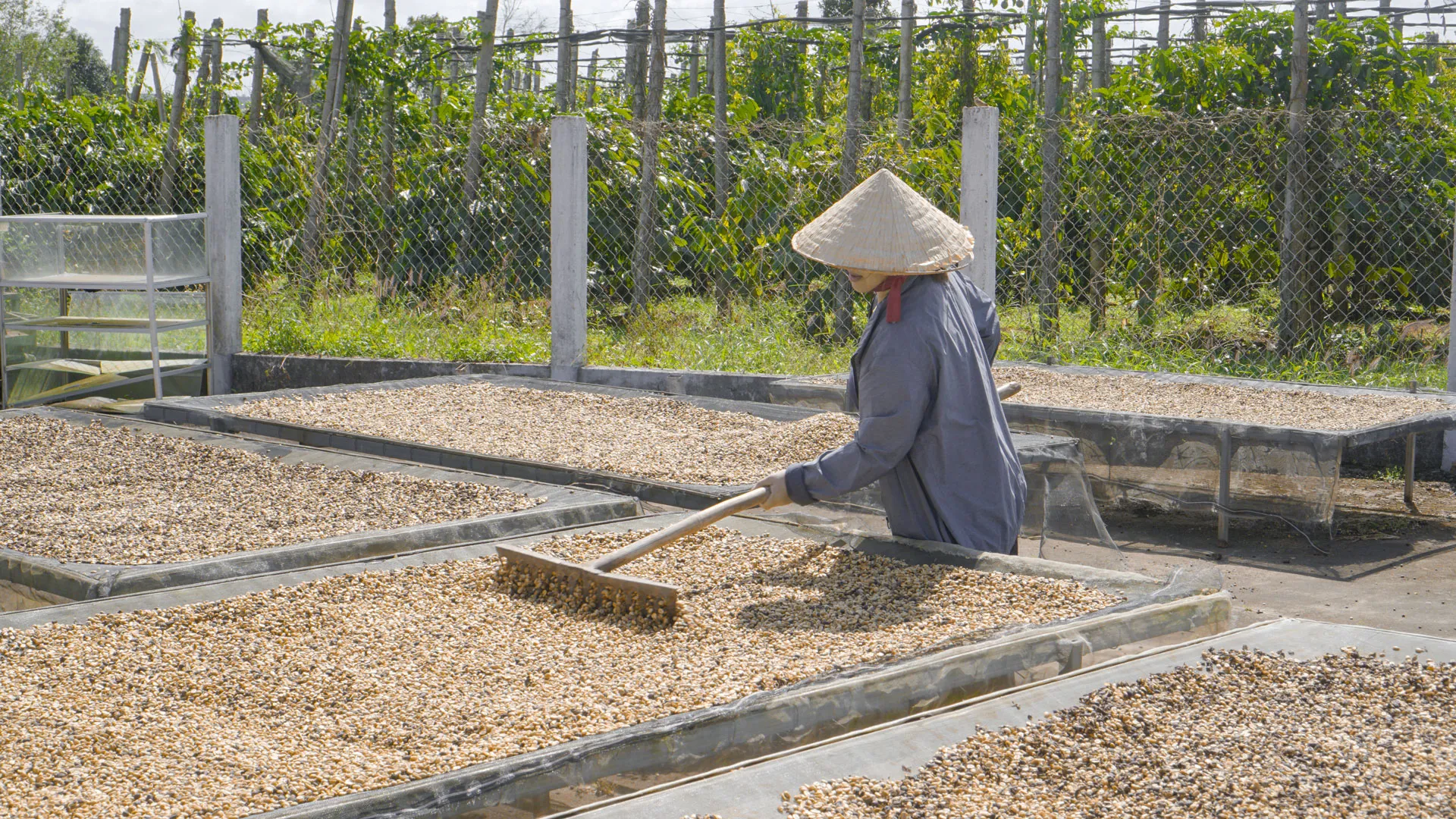
1300s operates from the Mang Den highlands of Kon Tum province as a vertically integrated producer, working directly with farming partners rather than through intermediaries or cooperative networks, with quality control managed through an in-house lab. The company holds ISO 22000, HACCP, and FDA registration. Relative to the larger exporters above, 1300s is positioned for EU buyers who want closer visibility into where a lot actually comes from, batch-level customization or private label options, and the ability to visit the origin directly through the company’s Kon Tum farm tour program. This structure also tends to make farm-level geolocation data more readily available than it typically is through cooperative-sourced supply chains, which is worth raising directly given the EUDR timeline above.
1300’S Coffee
Matching Supplier Type to What You’re Actually Sourcing
The five suppliers above aren’t interchangeable, and treating them as one homogenous “Vietnamese exporter” category is one of the more common mistakes European buyers make during first-time sourcing. Each operates at a different scale, works through a different sourcing structure, and is realistically a better fit for some import briefs than others. The table below summarizes how buyer needs tend to map onto supplier type, though it’s worth pairing this with a closer look at green coffee bean suppliers if your priority is unroasted lots specifically, or at private label coffee suppliers if the goal is a finished, branded product rather than raw beans.
| Buyer need | Better suited to |
|---|---|
| Large, predictable volume with EU certifications attached | Intimex, Simexco Daklak |
| Certified organic coffee with an established EU export history | Vinh Hiep |
| Documentation and grading already aligned to EU technical standards | NKG Vietnam |
| Farm-level traceability, smaller batches, private label or custom blends | 1300s |
Larger roasters, retail chains, and instant coffee manufacturers typically need bulk specialty coffee delivered on a predictable schedule, which favors specialty coffee suppliers with the infrastructure to handle high volume while still meeting EU certification requirements. Smaller specialty roasters, independent cafés, and brands building a private label line generally need more flexibility in batch size, faster sample turnaround, and closer contact with the actual sourcing decisions, which is where smaller, vertically integrated specialty coffee suppliers offering coffee specialty wholesale, or speciality coffee wholesale as it’s often spelled by UK buyers, at limited volume tend to fit better than the large multinational-backed exporters.
A Practical Sourcing Process for EU Importers
Knowing which supplier category fits your brief is only half the decision. The other half is running the actual evaluation in the right order, since most sourcing mistakes come from skipping a step rather than picking the wrong company outright. The sequence below reflects how experienced EU importers typically move from first contact to a confirmed order, whether they’re sourcing green coffee bean suppliers for in-house roasting, arabica coffee beans suppliers or robusta coffee beans suppliers for a specific blend, or a full OEM coffee manufacturer relationship for a private label line.
- Request cupping samples and lot-level specifications before discussing volume or price, and compare cupping scores against your own quality bar rather than relying on the supplier’s internal grading.
- Ask directly about EUDR readiness: what percentage of the supplier’s growing plots are currently geo-mapped, and what their plan is for the December 2026 (large/medium operators) or June 2027 (micro/small operators) deadlines.
- Verify certifications against EU-accredited certifying bodies, not just the certification name, since accreditation varies by region.
- Confirm Incoterms, minimum order quantities, and lead times against your logistics setup, and clarify whether pricing already reflects EVFTA’s zero tariff treatment.
- Scale from a trial order before committing to a full container, particularly with smaller or newer suppliers where consistency across batches hasn’t yet been tested at your required volume. If your logistics setup allows it, a facility visit through a coffee factory in Vietnam tour is generally more informative at this stage than another round of email correspondence.
Working through these steps in order also makes it easier to catch mismatches early, before they turn into a rejected container or a compliance gap discovered after the coffee is already in transit.
Getting Started
Before committing to one of Vietnam’s specialty coffee suppliers, European importers should request a sample lot, cupping results, and documentation on EUDR geolocation coverage and relevant certifications, then confirm minimum order quantities, lead times, and Incoterms against their logistics setup before scaling to a full container order. Sourcing specialty coffee suppliers for the European market? Request a sample and pricing details to see how origin, certification, and batch flexibility align with your import requirements.
Read more: Why Coffee Brands Choose Specialist Coffee Suppliers for Premium Products


1300s BLOG YOU MAY ALSO BE INTERESTED IN
Best Private Label Coffee Suppliers for Brands Ready to Launch Their Own Line
The Rise of Vietnam’s Specialty Coffee Industry
How to Choose a Trusted Specialty Coffee Supplier for Global Importers