




What Countries Import the Most Coffee Top Importing Markets Worldwide
Coffee production concentrates heavily in a handful of tropical producing countries, but consumption tells a genuinely different geographic story, and understanding what countries import coffee at the highest volumes reveals a demand landscape led overwhelmingly by wealthy, coffee-drinking nations far from the equatorial growing regions that actually produce the crop. This geographic mismatch between where coffee grows and where it’s actually consumed is what makes the entire global coffee trade possible in the first place, and it explains why international shipping, trade agreements, and import compliance requirements matter so much to an industry built around moving product across such vast distances between production and consumption. This guide breaks down the world’s leading coffee importing markets, why demand concentrates so heavily in these specific countries, and what this pattern means for suppliers and businesses trying to reach these buyers effectively.
What Countries Import Coffee The Global Demand Picture
Global coffee imports reached approximately 71.8 billion dollars in value during 2025, a substantial jump from 51.9 billion dollars the prior year, reflecting both genuine consumption growth and the price volatility that affected global coffee markets throughout the period. The top five importing countries, the United States, Germany, Italy, France, and Spain, together accounted for nearly half of this total value, illustrating just how concentrated global coffee demand actually is despite coffee being consumed in some form across nearly every country in the world. Looked at by continent rather than individual country, Europe alone accounted for roughly 56.8 percent of global import value, with North America contributing another 21.9 percent, meaning these two regions together represent close to four-fifths of all coffee imported worldwide, leaving the remainder split across Asia, which currently holds a smaller but rapidly growing share, along with the rest of the world.
United States the World’s Largest Importer
No answer to what countries import coffee is complete without starting with the United States, which holds the top position in global coffee imports by a clear margin.
Import Value and Consumption Scale
The United States imported roughly 9 to 12.8 billion dollars worth of coffee in recent reporting periods depending on the specific year and data source cited, consistently ranking as the single largest coffee importing nation in the world. This massive import volume reflects both America’s sheer population size and genuinely high per capita coffee consumption, with survey data suggesting roughly two-thirds of American adults drink coffee daily, a consumption habit that domestic production, concentrated in small operations in Hawaii and Puerto Rico, could never come close to satisfying on its own. This scale of dependence on foreign supply makes the United States genuinely unusual among major world economies, since most large consuming nations maintain at least some meaningful domestic production buffer, while American coffee demand rests entirely on international trade relationships that stretch across multiple continents and remain subject to everything from weather events at origin to shifting trade policy decisions made in Washington.
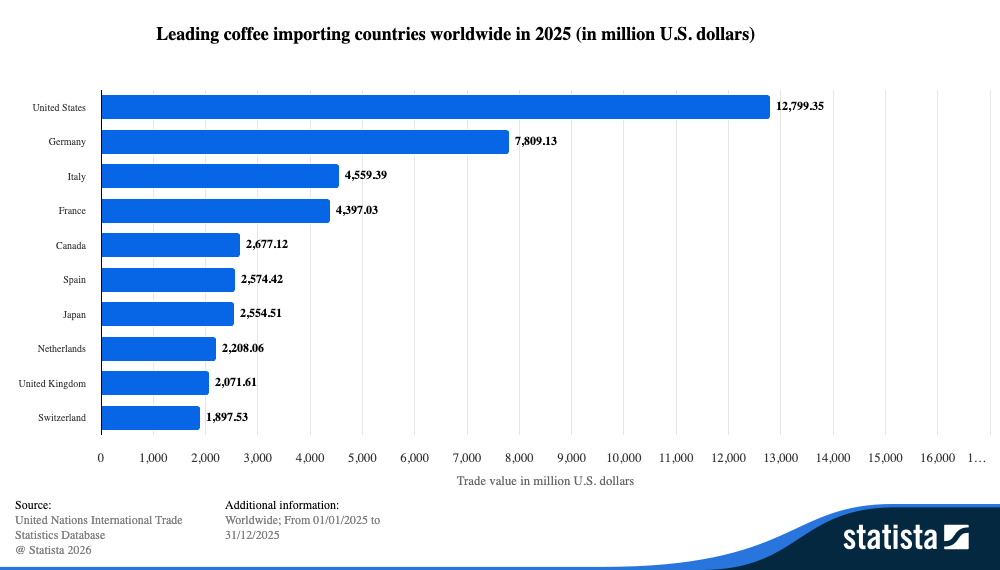
United States the World’s Largest Importer (Source: statista)
Diverse Sourcing to Meet Massive Demand
Given the scale of American demand, the US sources coffee from an unusually broad range of countries compared to smaller importing markets, with Brazil, Colombia, and Vietnam among the most significant suppliers, though dozens of additional origin countries contribute meaningfully to overall American import volume. This sourcing diversity partly reflects necessity, no single origin country, even Brazil at its enormous production scale, could realistically supply the entirety of American demand alone, forcing US importers, roasters, and major companies to maintain relationships across a genuinely wide network of producing countries, and it’s part of why so many established roasted coffee wholesale supply chains serving the American market draw from multiple origins simultaneously rather than depending on any single country.
Germany Europe’s Coffee Gateway
Germany holds the second position among global coffee importers, and its specific role within the European market differs meaningfully from a straightforward domestic consumption story alone.
Germany Import Volume and Role
Germany imported approximately 5.6 billion dollars worth of coffee in recent reporting, reflecting both substantial domestic consumption and the country’s position as a major processing and trading hub for the broader European market. German coffee culture runs deep historically, and the country maintains one of the highest per capita consumption rates in Europe, supporting a genuinely large direct consumption market independent of its broader trading role.
Germany as a Re-Export Hub
Beyond direct consumption, a meaningful share of coffee imported into Germany gets processed, roasted, or repackaged before re-export to other European markets, making Germany’s total import figures somewhat larger than domestic consumption alone would suggest. This re-export role has developed over decades of German investment in processing infrastructure and logistics specifically positioned to serve the broader European market, and businesses evaluating a ground coffee wholesale relationship with German processors specifically benefit from this established infrastructure, since a German-based supplier often already has the distribution network in place to reach the broader European market beyond German borders alone, giving the country an outsized position in European coffee trade relative to its population alone.
Italy France and the European Café Culture Markets
Italy and France round out the top five global importers, each anchored by deeply established café culture that shapes their specific import patterns. Italy, the birthplace of espresso, imports substantial volumes of both Arabica and Robusta specifically to support its domestic roasting industry, which itself exports finished roasted coffee and equipment to markets worldwide, making Italy simultaneously a major importer of green coffee and a significant exporter of finished coffee products and roasting expertise. This dual role, importer of raw material and exporter of finished culture and technology, gives Italy a genuinely distinct position among the world’s top importing countries, one built as much on decades of cultivated espresso expertise and brand reputation as on raw import volume alone. France imports coffee to support both its traditional café culture and a growing at-home brewing segment, with recent import data showing France’s total import value settling around 3.3 to 3.4 billion dollars, supplied by a broad mix of origin countries though with recent shifts showing declining volumes from some traditional suppliers alongside growth from others like Poland and Ethiopia, illustrating that even within established, mature importing markets, the specific mix of supplying countries continues to shift meaningfully from year to year rather than remaining fixed indefinitely.
Japan and the Rise of Asian Import Demand
Beyond the traditionally dominant Western markets, Asian importing countries have become an increasingly significant part of the global demand picture.
Japan Specialty and Convenience Focus
Japan imports around 1.5 billion dollars worth of coffee annually, importing roughly 380 million kilograms, with a market defined specifically by strong demand for both premium specialty coffee and convenient ready-to-drink formats including canned coffee, a format with particularly deep cultural roots in Japan compared to most Western markets. Japanese consumers show notably strong preference for sustainably sourced and certified coffee specifically, making certifications like Fair Trade genuinely important purchasing considerations in this market in a way that matters less in some other major importing countries. This combination of demanding quality expectations alongside genuine openness to convenient, ready-to-drink formats makes Japan a distinctly sophisticated market to enter, one where suppliers need to satisfy rigorous quality and certification standards even for products positioned around convenience rather than premium single-origin storytelling alone.
China and Emerging Asian Growth
China has posted some of the fastest import growth rates among any major coffee market in recent reporting periods, reflecting the same broader Asian shift toward coffee consumption that’s reshaping demand patterns across the region as younger, increasingly urban populations move away from tea as their exclusively dominant hot beverage. This growth trajectory, while still representing a smaller absolute import value than established Western markets, suggests the current concentration of import demand in a handful of wealthy Western nations may gradually shift over the coming decade as Asian consumption continues its current growth pace.
Why Import Demand Concentrates in These Markets
Wealth and established coffee-drinking culture together explain most of why import demand concentrates so heavily in this specific group of countries. Higher disposable income supports both higher per capita consumption volume and a greater willingness to pay premium prices for specialty and certified coffee, while decades or centuries of established coffee-drinking tradition, particularly across Europe, built the deep cultural habit that sustains such high per capita consumption in the first place. This combination of wealth and cultural habit reinforces itself over time too, established consumption creates the retail infrastructure, cafe density, and consumer familiarity that makes continued high consumption easier to sustain, while a market just beginning to develop coffee culture needs to build all of that infrastructure and familiarity from a much earlier starting point. Emerging markets with growing middle classes and urbanizing populations, particularly across Asia, are gradually building similar consumption habits, suggesting the current concentration among a small number of wealthy, culturally coffee-oriented nations will likely diversify further as these emerging markets continue developing their own coffee cultures over time.
Why Import Demand Concentrates in These Markets
What This Means for Suppliers Targeting These Markets
Understanding what countries import coffee at scale matters directly for how suppliers and exporters think about market entry and expansion priorities. A business building a roasted coffee wholesale export program should recognize that the concentrated top markets, the US, Germany, Italy, France, and Spain, represent the most immediately reachable large-scale demand, though competition within these established markets is correspondingly intense given how many established suppliers already serve them.
Businesses evaluating a ground coffee wholesale export strategy specifically should weigh whether to compete directly within these saturated top markets or instead target faster-growing but currently smaller import markets across Asia, where competition remains less entrenched even though total addressable demand is currently smaller than the established Western markets.
For businesses building a genuine specialty coffee supplier relationship targeting export markets, Japan’s specific emphasis on certified, sustainably sourced coffee represents a particularly good match for suppliers capable of providing genuine traceability and certification documentation, a market where this positioning commands real purchasing preference rather than functioning as a minor differentiator.
Businesses developing a broader specialty coffee wholesale export strategy should also consider that European markets, despite representing established, mature demand, continue showing genuine appetite for premiumization and traceability, meaning a well-documented, differentiated origin story still finds real traction even in these long-established importing markets rather than only appealing to newer, less mature demand centers.
Positioning Your Coffee Business for These Import Markets
Businesses considering an instant coffee wholesale export strategy should note that established markets like Switzerland and Germany already function as major hubs for soluble coffee processing specifically, meaning new entrants may find more room to differentiate by targeting a specific underserved segment, private label formulation for a specific retailer, for instance, rather than competing broadly against already dominant, established suppliers in these markets.
Businesses planning a larger instant coffee bulk buy relationship aimed at supplying these established import markets should factor in that buyers in mature markets typically expect considerably more rigorous documentation and consistency guarantees than buyers in newer, less developed import markets, reflecting the more sophisticated, experienced purchasing practices these established markets have developed over decades of coffee trade.
A drip coffee supplier targeting the Japanese market specifically stands to benefit from that country’s well-documented preference for convenient, high-quality formats, a genuinely strong cultural fit between this specific product category and an established, receptive consumer base already primed to value exactly what this format offers.
Getting Started
Whether you were simply curious what countries import coffee at the highest volumes or the question led you to think more strategically about which markets actually make sense for your own export or supply ambitions, understanding this concentrated demand landscape gives you a genuinely informed foundation for prioritizing where to focus your efforts. Looking to supply coffee into one of the world’s leading importing markets? Request a sample and a conversation with 1300’S Coffee to explore how Vietnamese origin coffee fits your target market’s specific demand.
Read more: Where Is Coffee Imported From Top Exporting Countries by Volume


1300s BLOG YOU MAY ALSO BE INTERESTED IN
Where Does the US Import Coffee From Volume and Top Source Countries
What Countries Import the Most Coffee Top Importing Markets Worldwide
How to Import Coffee A Step by Step Guide for New Importers