



How Much Is the Global Coffee Market Worth? Size Value and Key Numbers
Ask how much is the coffee industry worth and you’ll get a genuinely different answer depending on which research firm you ask, and the gap isn’t a disagreement about facts, it’s a difference in what each estimate actually counts. Published figures for the global coffee market in 2026 range from roughly 70 billion dollars on the narrow end to well over 400 billion dollars on the broadest estimates, a spread wide enough that citing any single number without context risks either understating or overstating the industry’s actual scale. This guide walks through the real numbers behind the global coffee market as of 2026, explains why published figures vary so dramatically, breaks the market down by segment and region, and looks at what this scale actually means for businesses sourcing coffee at any point in the supply chain.
How Much Is the Coffee Industry Worth The Numbers Explained
Before citing any specific figure, it’s worth understanding why this question doesn’t have one clean, universally agreed answer the way it might for a more narrowly defined market.
Why Estimates Range So Widely
Different research firms define the coffee market’s boundaries differently, and that scope decision drives most of the variation between published figures. Some estimates measure only retail packaged coffee sold through grocery and specialty channels, producing figures in the range of roughly 100 to 110 billion dollars for 2026. Others include the full value chain, foodservice, cafes, restaurants, and food service coffee sales alongside retail packaged product, pushing estimates considerably higher, into the 250 to 300 billion dollar range for the same year. A small number of the broadest estimates extend even further, incorporating adjacent categories and reaching figures north of 400 billion dollars. None of these numbers are wrong exactly, they’re answering slightly different questions about what actually counts as part of the coffee industry. This scope confusion matters practically too, not just academically, since a business comparing its own revenue or a specific market opportunity against a headline “coffee industry” figure needs to understand which scope that figure actually represents before drawing any meaningful conclusion about relative market position or opportunity size.
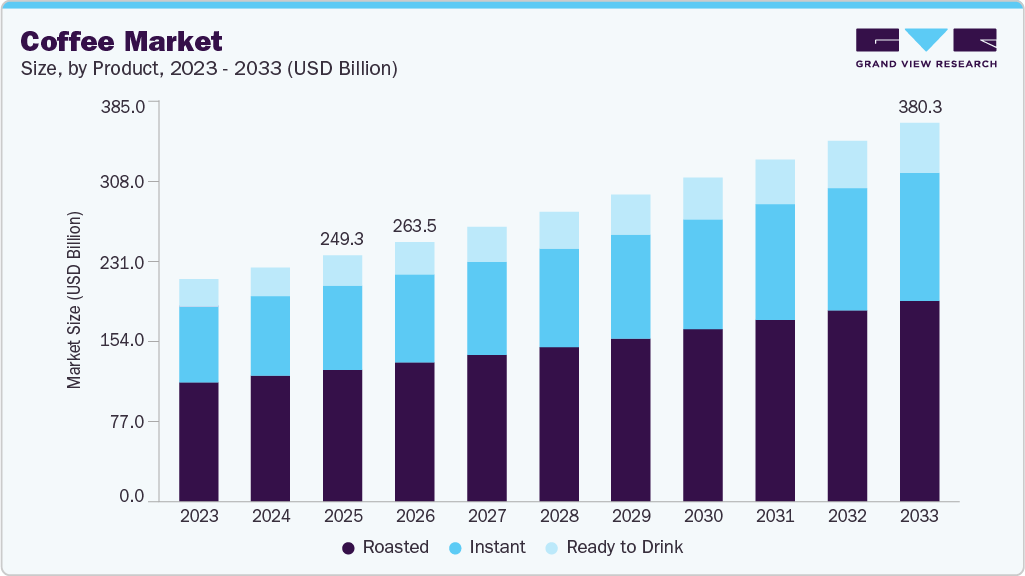
Coffee Market (Source: Grand View Research)
The Most Commonly Cited Figures
Among the more frequently referenced estimates for 2026, several major research firms place the global coffee market somewhere between 185 and 300 billion dollars, generally reflecting a combined retail and specialty market scope without extending into the broadest full value chain definitions. Growth projections across these estimates cluster around a 5 to 6.5 percent compound annual growth rate through the early 2030s, suggesting steady, if not explosive, expansion regardless of which specific baseline figure a given source starts from. When someone asks how much is the coffee industry worth without specifying scope, citing a figure in this 185 to 300 billion dollar range, while noting the definitional caveat, represents the most defensible general answer available from current published research. It’s also worth noting that these figures represent snapshots based on specific research methodologies and forecast assumptions, meaning they should be treated as reasonable estimates within a defensible range rather than precise, universally agreed measurements, an important distinction for anyone citing these numbers in a business context where precision matters.
Breaking Down the Market by Segment
Beyond the headline total, understanding how that value splits across different coffee formats reveals where growth is actually concentrated.
Roasted Coffee Still Leads
Roasted coffee, spanning both whole bean and ground formats, continues to account for the largest single share of global market revenue, generally cited around 53 to 54 percent of total value in recent industry reports. This dominant position reflects both the sheer scale of established retail and foodservice channels built around roasted coffee and the continued expansion of international coffee chains into new markets, reinforcing roasted coffee’s central role even as newer formats grow at faster individual rates. This segment’s stability also reflects deeply established consumer habits and brewing infrastructure, home coffee makers, espresso machines, and cafe equipment all built around roasted coffee specifically, an installed base that takes considerably longer to shift than consumer preference alone, giving this segment a durability that pure growth-rate comparisons between formats don’t always fully capture. Businesses evaluating a roasted coffee wholesale relationship, or a ground coffee wholesale supply line calibrated to specific brewing methods, are positioning within this largest and most established part of the market, a reasonably safe foundation for long-term product planning rather than a segment at meaningful risk of near-term decline.
Instant Coffee’s Growing Share
Instant coffee continues to hold a meaningful and, in some markets, expanding share of overall value, driven partly by affordability appeal in price-sensitive and emerging markets and partly by improving quality perception as manufacturers invest in better formulation and freeze-drying technology. This segment’s growth trajectory differs meaningfully by region, with some emerging markets showing particularly strong instant coffee adoption as coffee culture spreads into populations without established brewing habits or equipment. Businesses evaluating an instant coffee wholesale relationship, or planning a larger instant coffee bulk buy specifically targeted at these expanding regional segments, are positioning within a genuine growth opportunity rather than a shrinking or purely legacy category within the broader market.
Ready to Drink and Emerging Formats
Ready-to-drink coffee has emerged as one of the fastest-growing segments within the broader market, with some estimates placing its growth rate meaningfully above the market’s overall average CAGR, in certain projections exceeding 7.5 percent annually compared to the market’s broader 5 to 6.5 percent range. This format’s growth reflects broader consumer trends toward convenience and on-the-go consumption, and it represents one of the more dynamic areas of the industry even though it still accounts for a smaller absolute share of total market value than roasted or instant coffee. Cold brew and canned or bottled coffee beverages have driven much of this specific growth, benefiting from retail placement alongside other beverage categories rather than being confined purely to the traditional coffee aisle, giving this format shelf and marketing exposure that more traditional coffee formats don’t always receive in the same retail environments. Single-serve convenience formats more broadly, including a drip coffee supplier working with single-serve filter bags, are riding this same convenience-driven growth wave, sitting within one of the market’s more dynamic segments even at a currently smaller absolute scale than roasted or instant coffee.
Regional Breakdown Who Drives the Value
Europe consistently holds the largest regional share of global coffee market value across most published estimates, generally cited between 32 and 35 percent of total revenue, reflecting the region’s deep-rooted coffee consumption culture and dense concentration of both retail and specialty coffee shop channels. Germany specifically stands out within Europe as a leading national market, reflecting both strong per capita consumption and a well-developed specialty and retail coffee sector. North America represents the second largest regional market by most measures, with the United States specifically standing out for its high daily consumption rates, with recent survey data suggesting roughly two-thirds of American adults drink coffee daily, and its position as one of the world’s largest coffee importing markets given its own lack of domestic production capacity for coffee grown at meaningful commercial scale. This import dependence makes the US market particularly sensitive to origin country pricing and trade policy shifts, a dynamic that plays out differently than in Europe, where a broader mix of import sources and longer-established trade relationships provide somewhat more supply diversification.
Asia-Pacific, despite currently holding a smaller absolute share compared to Europe and North America, consistently posts the fastest projected growth rate among major regions, driven by rising disposable incomes and a younger, increasingly urban population shifting toward coffee consumption in markets historically dominated by tea. India and China specifically appear repeatedly among the fastest-growing individual country markets in recent industry analysis, reflecting this broader Asia-Pacific growth pattern playing out at a national level, with some projections placing individual country growth rates in the high single digits, meaningfully above the broader global market average. This regional growth divergence matters directly for businesses planning long-term market entry or expansion strategy, since a market currently smaller in absolute terms but growing considerably faster represents a genuinely different opportunity profile than a larger but more mature, slower-growing market like Europe or North America.
What’s Driving Growth in the Coffee Industry
Beyond simple population and income growth, several specific trends explain why the coffee market continues expanding at a meaningfully faster pace than overall economic growth in most major markets.
Premiumization and Specialty Demand
A significant share of current market growth traces back to premiumization, consumers increasingly willing to pay more for higher quality, traceable, and sustainably sourced coffee rather than simply the cheapest available option. This shift has meaningfully benefited the specialty segment specifically, and it’s part of why vertically integrated producers and roasters emphasizing traceability have gained relevance even as overall market growth remains moderate rather than explosive at the aggregate level. This premiumization trend also shows up clearly in how buyers describe their purchasing priorities in industry surveys, with sustainability credentials, origin transparency, and specific processing methods increasingly cited as purchase drivers alongside the more traditional factors of flavor and price, a genuine shift in what actually drives purchasing decisions compared to a decade or two ago when price and basic brand recognition dominated most consumer decision-making around coffee. Businesses positioning around this trend, working with a genuine specialty coffee supplier rather than commodity grade sourcing alone, are aligning with what’s actually driving current growth rather than betting on a segment likely to lose relevance.
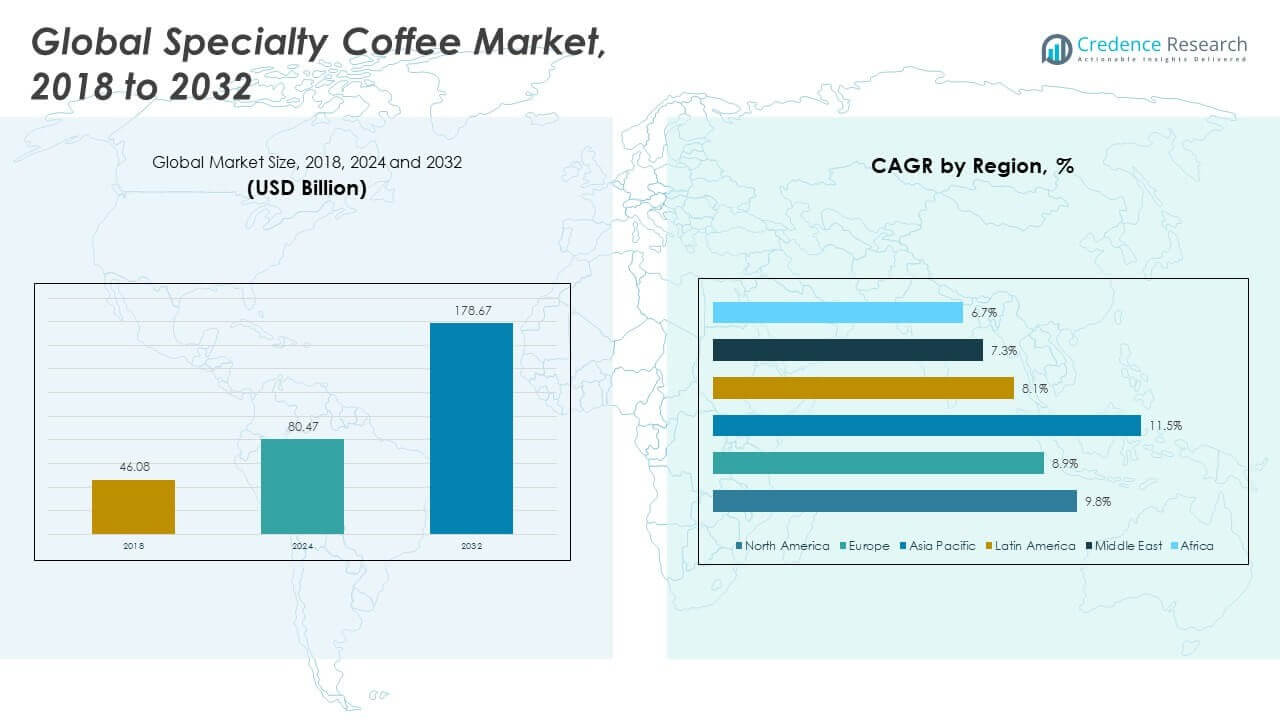
Specialty Coffee Market Size (Source: Credence Search)
Robusta’s Rising Value
Robusta coffee has posted notably strong growth in recent market analysis, in some projections outpacing Arabica’s growth rate specifically, a genuine shift from the traditional assumption that Robusta would remain purely a lower-value commodity component of the market. This reflects the broader Fine Robusta movement covered extensively elsewhere in coffee industry discussion, where more careful processing and quality control have allowed Robusta to capture real value that would have gone exclusively to Arabica in previous decades. Vietnam’s position as the world’s largest Robusta producer places the country at the center of this specific market shift, and the price dynamics behind it, domestic Robusta prices in Vietnam actually surpassed Arabica for the first time in 2024, reflect genuine quality-driven demand rather than a temporary market anomaly, a trend with real implications for how buyers evaluate Robusta sourcing decisions going forward rather than defaulting to older assumptions about the varietal’s inherent value ceiling. This shift also carries implications for how the broader market value gets distributed geographically, since a larger share of value captured by Robusta specifically tends to benefit origins like Vietnam more directly than origins historically focused primarily on Arabica production alone.
Coffee Production Volume vs Market Value
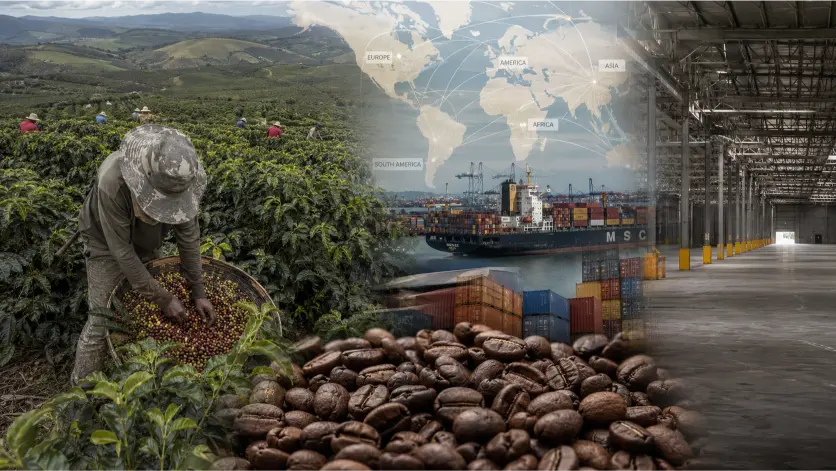
It’s worth distinguishing production volume from market value when discussing how much is the coffee industry worth, since these are related but genuinely different measures. Global coffee production is typically measured in 60-kilogram bags, with recent industry data placing annual global production somewhere in the range of 170 to 175 million bags, a figure that reflects the raw agricultural output before any processing, roasting, or retail markup gets applied. Market value, by contrast, captures everything added on top of that raw production, processing, roasting, packaging, distribution, retail and foodservice markup, which is why market value figures run into the hundreds of billions of dollars while the underlying raw commodity value of unprocessed green coffee represents a comparatively small fraction of that total. This gap between production volume and market value illustrates a broader point about where the actual profit and value creation happens within the coffee supply chain, farmers and producers, who generate the raw agricultural product, generally capture a meaningfully smaller share of total market value than the processing, branding, and retail stages further downstream, a structural imbalance that’s driven considerable discussion around fair trade and more equitable value distribution throughout the industry in recent years. Businesses building a genuine specialty coffee wholesale program specifically often try to correct part of this imbalance directly, since specialty positioning typically involves paying producers a meaningfully higher price for the same raw volume compared to commodity grade purchasing.
What This Scale Means Going Forward
The specific numbers covered throughout this guide matter less in isolation than the overall pattern they reveal, a market large enough to support many different business models and scales, growing steadily rather than explosively, with meaningfully different growth rates across regions, segments, and quality tiers. A business entering or expanding within this market benefits more from understanding where the actual growth is concentrated, premiumization, specialty positioning, Robusta’s rising relative value, faster-growing regions like Asia-Pacific, than from fixating on any single headline market size figure, since that figure’s usefulness depends entirely on matching its scope to whatever specific business question is actually being asked.
Getting Started
Whether you were simply curious how much is the coffee industry worth or the question led you to think more seriously about where your own business fits within this multi-hundred-billion-dollar market, understanding both the scale and the specific growth drivers covered here gives you a genuinely informed foundation for evaluating opportunity within the space. Looking to source coffee within a growing, premiumizing market segment? Request a sample and a conversation with 1300’S Coffee to explore where your business fits within today’s coffee industry.
Read more: What Is Specialty Grade Coffee? The Criteria That Actually Define It


1300s BLOG YOU MAY ALSO BE INTERESTED IN
How Long Can Green Coffee Beans Be Stored: Shelf Life and Best Practices
Where Do Coffee Beans Come From: A Guide to Origin and the Journey to Your Cup
Why Vietnam Is Becoming a Global Specialty Coffee Origin